
Showing posts with label features. Show all posts
Showing posts with label features. Show all posts
February 1, 2010

Black Panthers Ericka Huggins Oakland Laney College
By Reginald James
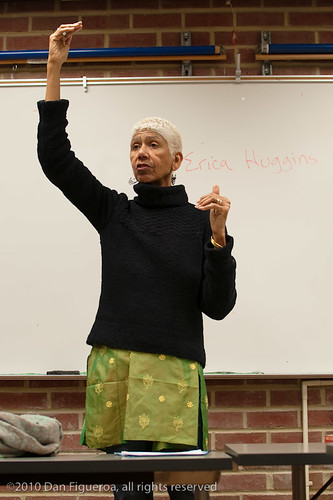 Activist stresses human value of women, need for men to work to end sexism
Activist and former Black Panther leader Ericka Huggins addressed an overflowing African American Studies class Feb. 22 at Laney College.
As a part of campus' Black History Month program, Huggins engaged students in a discussion themed, “Women, Social Justice and Economics.” She discussed the historical dehumanization and discrimination Black women faced and how the “multi-generational trauma” of slavery has forced Black women to face dual oppression due to both race and gender.
Black women were a commodity, and “not just (their) labor, but bodies were sold,” Huggins said. “Slavery was economic leverage for everything else that happened to other people immigrating, migrating or forced to be here” in America.
This legacy of oppression has led to some women internalizing feelings of inferiority, and even self-hatred, Huggins said.
“If she’s taught she has no right to respond, she will accept it and go into a shell,” Huggins said, referring to how women react to sexism. “Rather than explode in confrontation, she will implode.
“She might begin to hate herself.”
Huggins told the story of Johnnie Tillman, an early 20th century female activist who founded the National Welfare Rights Organization in response to Black women being barred from receiving welfare. Refuting the stereotype of Black women as “welfare queens” in a “culture of poverty,” she told the story of women fighting for dignity, while seeking assistance. She called the suggestion that women would have a baby for the purpose of collecting a check, “male-thinking.”
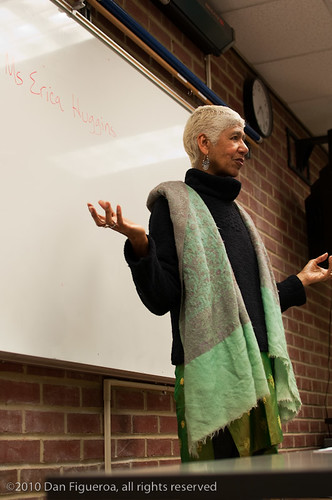 As a single mother and member of the Black Panther Party, working 19 hour days, Huggins received welfare. She felt dehumanized, not because she received public assistance, but because her male case worker spied on her and invaded her privacy, like a slave plantation.
“During that time, I’ve never been so devalued and humiliated in my life,” Huggins explained. Even after Tillman’s struggle, “the vestiges of discriminatory policies in welfare remained.
Huggins was widowed when her husband, John Huggins, was assassinated at UCLA by the FBI’s Counterintelligence Program (COINTELPRO), she said. People would judge her negatively because she was a single parent, not knowing why.
Not deterred from the struggle, the former director of the Panther’s Oakland Community School is still an educator. She currently teaches Women’s Studies at Cal State East Bay and San Francisco State. However, due to budget cuts, she will not be able to teach in the fall. She encouraged students to be organized to created a world they want to live in. She asked students for suggestions on improve conditions for women in the U.S.
“We can mobilize women, joining together with men so that we can pressure the state to allocate more funds to programs we need,” Laney College student Terez McCall said.
Huggins concluded that, “If Johnnie Tillman started the National Welfare Rights Organization in a little room in a housing project in Arkansas, each of us can step up and step forward.”
“We think we can’t because we’ve been told that we’re powerless, we can do things.”
Photos courtesy of DanFigPhoto.com
This article originally appeared on TheBlackHour.com.
Activist stresses human value of women, need for men to work to end sexismActivist and former Black Panther leader Ericka Huggins addressed an overflowing African American Studies class Feb. 22 at Laney College.
As a part of campus' Black History Month program, Huggins engaged students in a discussion themed, “Women, Social Justice and Economics.” She discussed the historical dehumanization and discrimination Black women faced and how the “multi-generational trauma” of slavery has forced Black women to face dual oppression due to both race and gender.
| “If she’s taught she has no right to respond, she will accept it and go into a shell. Rather than explode in confrontation, she will implode. She might begin to hate herself." Ericka Huggins, on sexism |
This legacy of oppression has led to some women internalizing feelings of inferiority, and even self-hatred, Huggins said.
“If she’s taught she has no right to respond, she will accept it and go into a shell,” Huggins said, referring to how women react to sexism. “Rather than explode in confrontation, she will implode.
“She might begin to hate herself.”
Huggins told the story of Johnnie Tillman, an early 20th century female activist who founded the National Welfare Rights Organization in response to Black women being barred from receiving welfare. Refuting the stereotype of Black women as “welfare queens” in a “culture of poverty,” she told the story of women fighting for dignity, while seeking assistance. She called the suggestion that women would have a baby for the purpose of collecting a check, “male-thinking.”
As a single mother and member of the Black Panther Party, working 19 hour days, Huggins received welfare. She felt dehumanized, not because she received public assistance, but because her male case worker spied on her and invaded her privacy, like a slave plantation.“During that time, I’ve never been so devalued and humiliated in my life,” Huggins explained. Even after Tillman’s struggle, “the vestiges of discriminatory policies in welfare remained.
Huggins was widowed when her husband, John Huggins, was assassinated at UCLA by the FBI’s Counterintelligence Program (COINTELPRO), she said. People would judge her negatively because she was a single parent, not knowing why.
| "If Johnnie Tillman started the National Welfare Rights Organization in a little room in a housing project in Arkansas, each of us can step up and step forward.” Ericka Huggins |
“We can mobilize women, joining together with men so that we can pressure the state to allocate more funds to programs we need,” Laney College student Terez McCall said.
Huggins concluded that, “If Johnnie Tillman started the National Welfare Rights Organization in a little room in a housing project in Arkansas, each of us can step up and step forward.”
“We think we can’t because we’ve been told that we’re powerless, we can do things.”
Photos courtesy of DanFigPhoto.com
This article originally appeared on TheBlackHour.com.
Tim Wise: Racism still plagues America
Even with the election of President Barack Obama, America is still plagued by racism, according to author and activist Tim Wise.

About 150 people packed Laney College's Room D-200 Wednesday, Feb. 3 to hear the Black History Month lecture based on Wise’s most recent book, “Between Barack and a Hard Place: Racism and White Denial in the Age of Obama.”
Wise -- who is white -- said the recent economic downturn, fear over health care reform, the changing demographics of America, and the election of the first African American president in the U.S. has caused great anxiety for white people in America. The rise of the “Tea Party” demonstrations and much of the backlash against the Obama administration is due to a perceived loss of “white privilege.”
"For the first time you actually have to realize that America’s not just about white folks,” Wise said, referring to the luxury of America being seen as a nation for white people. “When all of a sudden that changes, an awful lot of people aren’t ready.”
“All of a sudden you have a white America” no longer “totally convinced that everything’s going to be okay. He added that the economic collapse has caused many white people to feel as if they are “losing” the country and wanting “their” country back. “They’re talking about going back to the day when they were the norm. They could take it for granted that they were the norm.”
He added that it could make it difficult for white people to discuss race or racial inequality when they have their own problems to deal with. Wise suggests this is the time when people of all races should unite to solve the country’s collective problems, but it isn’t happening.
The election of the first Black president has lead to increased “rhetoric of racial transcendence,” Wise said, even though the majority of white people did not vote for Obama. He said that Obama has avoided discussing race unless he is forced to, and gave the example of Obama’s campaign speech on race when he was forced to distance himself from his former pastor, the Rev. Jeremiah Wright.
Ironically, “the very thing that allowed him to win was the idea that he’s different,” from other Black people, Wise said. “Yet, it’s the very thing that now makes it impossible for him to respond to even the overtly racist stuff that gets thrown at him.”
“It was President Obama who implanted this notion in the minds of the American public,” Wise said, referring to Mr. Obama’s 2004 speech at the Democratic National Convention that put him on the national scene.
In that speech, Obama said, “There’s not a black America and white America and Latino America and Asian America; there’s the United States of America.”
Mr. Obama never mentioned race during his first State of the Union address, Wise said. Wise referred to MSNBC host Chris Matthews’ recent remark about Obama being “post-racial.”
"I forgot that he was black for a whole hour," Matthews said. Wise said that Obama probably didn’t forget he was black, but Matthews’ comment is evidence of inherent white privilege and negative connotations of black people.
The statement implies that Black people can only specialize in “black issues” and are incapable of being leaders of all people, Wise said.
"It’s a damned good thing I forgot" Obama was black, and “if I remembered I wouldn’t have been able to listen,” Wise said the remark implied. “Somehow there is something wrong with blackness that needs to be forgotten.
“Only white people have been able to erase our racial identity and act like it doesn’t matter, and forget that we’re white.
“Whenever you’re a member of a dominant group,” Wise said, “you have that luxury; the problem is when you project that luxury onto others who don’t have it.”
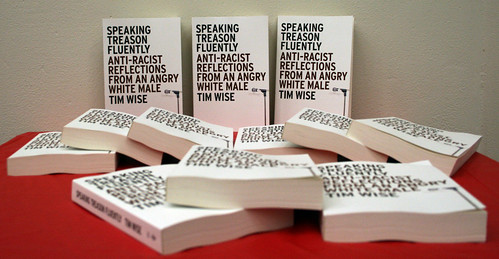
The lecture was followed by a question-and-answer period.
Responding to a question about the rise of hate groups following Obama’s election, Wise said “People of color are far more at risk of people not necessarily in hate groups.” Wise referring to police officers and loan officers who may be or may not be racist, but work in racist institutions. “Oscar Grant wasn’t a killed by a Klansmen,” he said.
When asked about the use of the “N-Word,” Wise stated that it was a “Black conversation” that did not need to involved white people in the decision.
His advice on confronting subtle or subconscious racism was critical confrontation. He said some whites may not be conscious of their racism, but by asking questions or critiquing racist remarks or statements, you can encourage people–who are not overtly or intentionally racist, to improve.
“You don’t want to just jump on them, you want them to think.”
Photos: Reginald James/ TheBlackHour.com
This article original appeared on TheBlackHour.com.
About 150 people packed Laney College's Room D-200 Wednesday, Feb. 3 to hear the Black History Month lecture based on Wise’s most recent book, “Between Barack and a Hard Place: Racism and White Denial in the Age of Obama.”
Wise -- who is white -- said the recent economic downturn, fear over health care reform, the changing demographics of America, and the election of the first African American president in the U.S. has caused great anxiety for white people in America. The rise of the “Tea Party” demonstrations and much of the backlash against the Obama administration is due to a perceived loss of “white privilege.”
'For the first time you actually have to realize that America’s not just about white folks.'
Tim Wise
"For the first time you actually have to realize that America’s not just about white folks,” Wise said, referring to the luxury of America being seen as a nation for white people. “When all of a sudden that changes, an awful lot of people aren’t ready.”
“All of a sudden you have a white America” no longer “totally convinced that everything’s going to be okay. He added that the economic collapse has caused many white people to feel as if they are “losing” the country and wanting “their” country back. “They’re talking about going back to the day when they were the norm. They could take it for granted that they were the norm.”
He added that it could make it difficult for white people to discuss race or racial inequality when they have their own problems to deal with. Wise suggests this is the time when people of all races should unite to solve the country’s collective problems, but it isn’t happening.
The election of the first Black president has lead to increased “rhetoric of racial transcendence,” Wise said, even though the majority of white people did not vote for Obama. He said that Obama has avoided discussing race unless he is forced to, and gave the example of Obama’s campaign speech on race when he was forced to distance himself from his former pastor, the Rev. Jeremiah Wright.
Ironically, “the very thing that allowed him to win was the idea that he’s different,” from other Black people, Wise said. “Yet, it’s the very thing that now makes it impossible for him to respond to even the overtly racist stuff that gets thrown at him.”
“It was President Obama who implanted this notion in the minds of the American public,” Wise said, referring to Mr. Obama’s 2004 speech at the Democratic National Convention that put him on the national scene.
In that speech, Obama said, “There’s not a black America and white America and Latino America and Asian America; there’s the United States of America.”
Mr. Obama never mentioned race during his first State of the Union address, Wise said. Wise referred to MSNBC host Chris Matthews’ recent remark about Obama being “post-racial.”
'Only white people have been able to erase our racial identity and act like it doesn’t matter, and forget that we’re white. Whenever you’re a member of a dominant group, you have that luxury; the problem is when you project that luxury onto others who don’t have it.'
Tim Wise
"I forgot that he was black for a whole hour," Matthews said. Wise said that Obama probably didn’t forget he was black, but Matthews’ comment is evidence of inherent white privilege and negative connotations of black people.
The statement implies that Black people can only specialize in “black issues” and are incapable of being leaders of all people, Wise said.
"It’s a damned good thing I forgot" Obama was black, and “if I remembered I wouldn’t have been able to listen,” Wise said the remark implied. “Somehow there is something wrong with blackness that needs to be forgotten.
“Only white people have been able to erase our racial identity and act like it doesn’t matter, and forget that we’re white.
“Whenever you’re a member of a dominant group,” Wise said, “you have that luxury; the problem is when you project that luxury onto others who don’t have it.”
The lecture was followed by a question-and-answer period.
Responding to a question about the rise of hate groups following Obama’s election, Wise said “People of color are far more at risk of people not necessarily in hate groups.” Wise referring to police officers and loan officers who may be or may not be racist, but work in racist institutions. “Oscar Grant wasn’t a killed by a Klansmen,” he said.
When asked about the use of the “N-Word,” Wise stated that it was a “Black conversation” that did not need to involved white people in the decision.
His advice on confronting subtle or subconscious racism was critical confrontation. He said some whites may not be conscious of their racism, but by asking questions or critiquing racist remarks or statements, you can encourage people–who are not overtly or intentionally racist, to improve.
“You don’t want to just jump on them, you want them to think.”
Photos: Reginald James/ TheBlackHour.com
This article original appeared on TheBlackHour.com.


